What are we eating?
What's for lunch?
What should I make for dinner?
Some questions come up in every home. The words change, the person asking changes, but sooner or later it's time to eat and someone asks the same thing.
And the answer almost always sounds the same, too:
"I don't know. What do you want?"
The funny thing is, we actually do know.
We know how to cook far more things than we can remember in that moment.
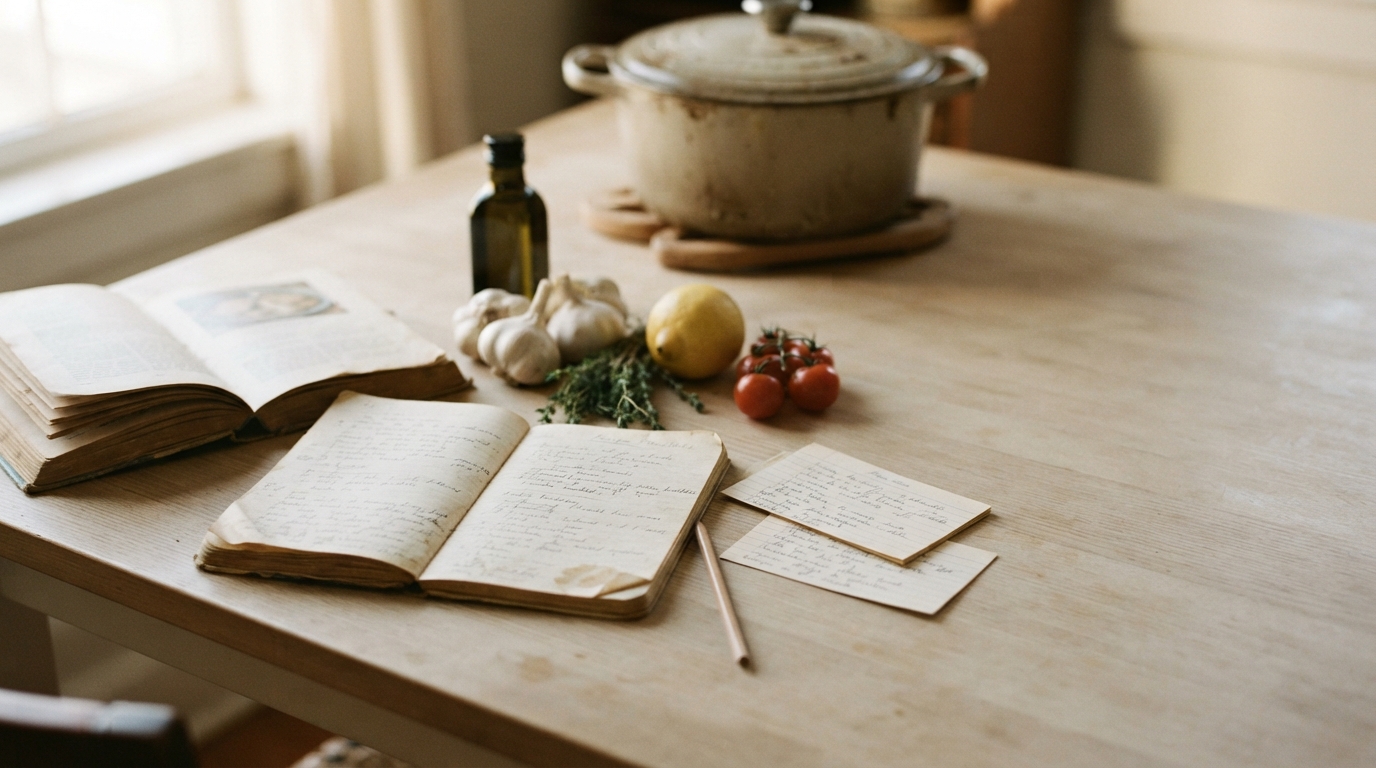
We have our parents' recipes, our grandparents' recipes, dishes we picked up from friends, things we saw somewhere once that ended up staying in the family for good. We have meals we've been making for years and others we discovered recently and loved.
We can make meatloaf the way Mom used to make it. We remember that stew our grandmother used to cook. We have a pasta that always turns out well, a casserole that gets us through the week, something special we make when we have more time, and a handful of dishes we know everyone in the house likes.
All of that is right there.
The problem is remembering it at the exact moment someone asks what we're eating.
We're not short on recipes
The internet solved the problem of finding recipes a long time ago.
If we want to learn to make ramen, a Spanish tortilla, curry, focaccia, or pretty much any dish in existence, thousands of recipes are just seconds away.
And yet we still find ourselves opening the fridge at eight at night thinking:
So what are we making for dinner?
Maybe the problem was never that we needed more recipes.
Maybe we needed a way to remember our own.
Because when we're figuring out what to eat on a random Tuesday, we're not searching through every meal that exists in the world. We're trying to choose among the meals that are part of our kitchen.
The ones we know.
The ones we like.
The ones we know how to make.
And the new ones we tried once and decided we want to make again.
Our kitchen is a repertoire, too
There's something nice about thinking of our kitchen that way.
Not as an endless collection of recipes saved somewhere, but as a repertoire we've built up over time.
Some recipes come from our family.
Others we learned on our own.
Some we make almost from memory. Others still need us to double-check the amounts or the steps. Some show up every week, and others only once in a while.
But they all have one thing in common: at some point, we decided we want them to be part of what we eat.
And that repertoire is probably much bigger than it feels when it's time to cook.
The problem is that our memory doesn't work like a menu.
When someone asks "what are we eating?", a neat list of every dish we know doesn't magically appear in front of us.
Three or four show up.
The same ones as always.
And after that, nothing.
Olivara was born from that question
Olivara was born, quite literally, from that moment.
Not from thinking the world was missing yet another app with thousands of recipes to discover.
Just the opposite.
It was born from realizing that we already know plenty of things we like to eat — we're just terrible at remembering them when we have to decide.
So the idea is pretty simple: keep the dishes that are part of our kitchen in one place.
The old standbys, and the new ones we consciously want to bring in.
Then, when it's time to plan the week, we don't have to start from scratch.
We can look at our dishes and decide: this one on Monday, that one on Tuesday, and on Wednesday let's make that recipe we haven't had in months.
From those decisions come the ingredients we need and, finally, the shopping list.
The question stops being:
"What could I cook?"
and becomes:
"Which of our dishes do we want to eat?"
It seems like a small difference.
But when evening comes around and someone asks again...
What are we eating?
...having the answer at hand changes quite a bit.